← Hayeon Song KO · EN

In accordance with a confidentiality agreement, some figures, revenue, and internal operational data have been modified or omitted.

Project · Nextunicorn UA → Networking → Revenue

Drove startup acquisition,
activated connections, and scaled the revenue structure

Nextunicorn is a platform providing information, networking, and early-stage investment solutions for startups and investors. It helps connect startups seeking early investment with investors, and delivers relevant insights. The platform's business model is based on providing startups with paid access to investment market intelligence and networking opportunities.

Networking Startup Investor Browse Investors Select Investor Contact Investor IR Deck Subscription Apply to Programs Browse Startups Select Startup Contact Startup

As a solo marketer, I designed and operated every channel from acquisition to monetization. I built the measurement infrastructure first, then structurally connected Paid channel optimization, SEO, and CRM on top of it.

CAC

47%

vs. Repurchase Target

101%

Monthly Avg. Blended ROAS

133%

Nextunicorn's primary revenue comes from payments made by startup users. Startup users purchase tickets to network with investors, and subscribe to the IR document service to access investor reference materials.

1. Expand the share of investment deals facilitated through the platform.

2. Grow the platform's influence within the startup ecosystem.

As Nextunicorn's sole marketer, I owned all channels — Paid, SEO, CRM, and promotions — end to end. I led a unified communication strategy covering the full funnel: from acquisition, to networking activation (retention), to subscription and repurchase (monetization). I collaborated with the PM, data analyst, developers, and graphic designer on analytics infrastructure, experiment design, and channel operations.

How I Work

Cross-Functional Collaboration & Working Process

As the sole marketer, I worked across product, data, and design to build measurement infrastructure and growth systems from scratch. Here's how I structured that collaboration.

hub Stakeholder Map

Sole marketer managing all channels — with cross-functional alignment

At Nextunicorn, I was the only marketer owning the entire growth stack — from paid acquisition and SEO to CRM lifecycle and measurement infrastructure. This required constant alignment with the PM, data analyst, and engineering team to define priorities, share attribution data, and coordinate product-side changes that affected user flows.

Decision Maker Contributor Informed Sole marketer — owned all channels end-to-end Marketing (Me) Sole marketer · all channels Owns full funnel CEO Strategy · budget · priority PM Product roadmap · spec Data Analyst SQL · dashboard · funnel Engineering GTM · event tags CTO Tech stack · infra Designer Landing · creative Report performance ← Budget · direction Feature request Query → Data → Tag spec request → GTM · tracking → Brief creative Ad-hoc Weekly sync Per-project Ad-hoc Async · Slack Monthly
PM Data Analyst Engineering CEO Design
schema User Flow & Measurement Architecture

Building measurement infrastructure and user journey maps from zero

When I joined, there was no attribution framework, no UTM taxonomy, and no structured funnel tracking. I built the measurement foundation (UTM → GTM → conversion tags → attribution) and mapped dual user journeys (startup vs. investor) to design CRM flows that matched each side's behavioral patterns.

Nextunicorn — Startup Investment & Networking Journey COMMON STARTUP INVESTOR MKT Browse Platform Sign-up Account create Verification ID · profile User type fork Upload IR Company profile Get Discovered Investor views Ticket Purchase Contact investor ★ Revenue KPI Networking Meet investor Subscribe IR doc access Repurchase Renewal Networking Browse startups Consultation Meeting Repeat Usage Re-engagement Deal Source Investment lead ← Startup contacts Investor (ticket required) · Investor browses Startups → Paid UA — Acquisition (SA · Meta DA · SEO · Content) Browse → Sign-up → Verification 유도 Onboard Profile CRM IR Upload Startup nudge Networking Social proof Ticket Nudge Purchase CRM Subscribe Conversion Retention Churn prev. Re-engage Reactivation Common step Startup Investor MKT Revenue milestone
check_circle UTM taxonomy & GTM conversion tracking built from scratch
check_circle Dual user journey mapping (startup vs. investor)
check_circle Channel-level attribution framework
check_circle SQL-based funnel analysis and cohort tracking
forum Communication & Async Collaboration

Structured reporting and cross-team alignment as sole marketer

As the only marketer, clear communication was critical. I maintained structured documentation for every campaign, built shared dashboards for subscription/networking metrics, and ran weekly syncs with PM and data teams.

dashboard Shared Dashboards

Built subscription/networking performance dashboards with the data team — shared across PM, CEO, and engineering for weekly review and priority alignment.

campaign Campaign Documentation

Every campaign (paid, CRM, SEO) documented with goals, target segments, creative rationale, and post-campaign analysis — creating a reusable knowledge base.

handshake Stakeholder Updates

Monthly marketing performance reports to CEO with channel-level ROI breakdown, experiment learnings, and next-period priorities — keeping leadership aligned on growth strategy.
01
THE CHALLENGE

Both of Nextunicorn's revenue streams depended on a single prerequisite: startups actually experiencing meaningful connections with investors. When investor response rates were low, startups gave up on networking — and neither ticket repurchases nor subscription conversions followed.

02
MEASUREMENT & CHANNEL DIAGNOSIS

Without measurement, there was no starting point for improvement

Paid traffic was the dominant source, with Meta accounting for roughly 50% of total traffic. However, most campaigns were operated purely for traffic volume, and post-acquisition engagement and conversion efficiency had never been properly validated. The first-page bounce rate after paid acquisition was over 70%, and sign-up conversion was nearly nonexistent. More fundamentally, the measurement foundation itself was broken. Around 40% of traffic sources were unidentifiable, LTV and tCAC benchmarks had never been defined, and there were persistent discrepancies between ad platform data and internal logs. It was impossible to begin channel optimization without being able to determine which channels were actually driving conversions.

View Ads
Tap Ads CTA
View Landing Page
Click Landing Page CTA
Sign-Up

Medium : Meta
tCAC : ?

Churn Rate : 70%

Churn

Analytics Infrastructure Setup

Before improving channel efficiency, the first step was building a measurable structure. When I joined, UTM conventions, event schemas, conversion tags, and internal log standards all varied by team — making it impossible to determine which traffic sources were actually driving sign-ups. I rebuilt the analytics foundation so that the entire journey from acquisition to conversion could be tracked against a consistent standard.

  1. 1. UTM Convention Standardization
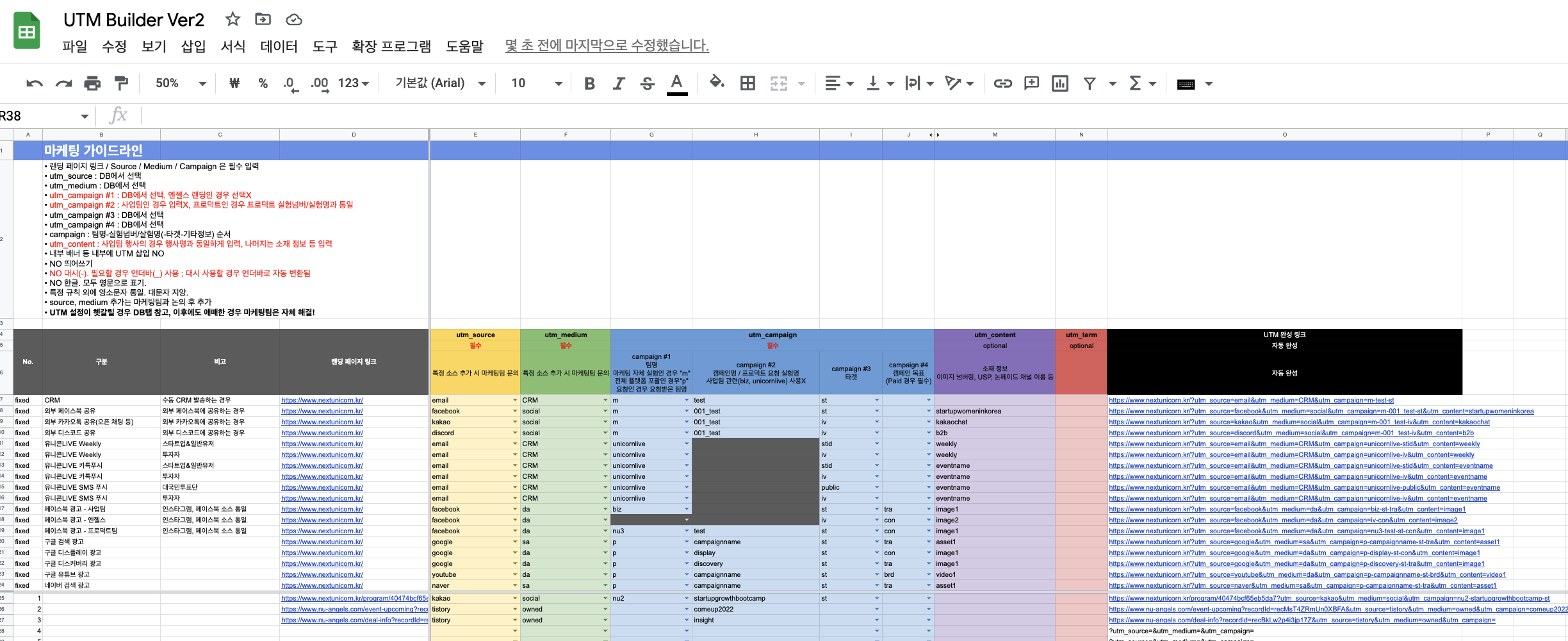
    Unified the acquisition parameter standards that had been used inconsistently across teams, and built an internal UTM Builder to standardize channel operations and data collection.
  2. 2. Event Schema Redesign
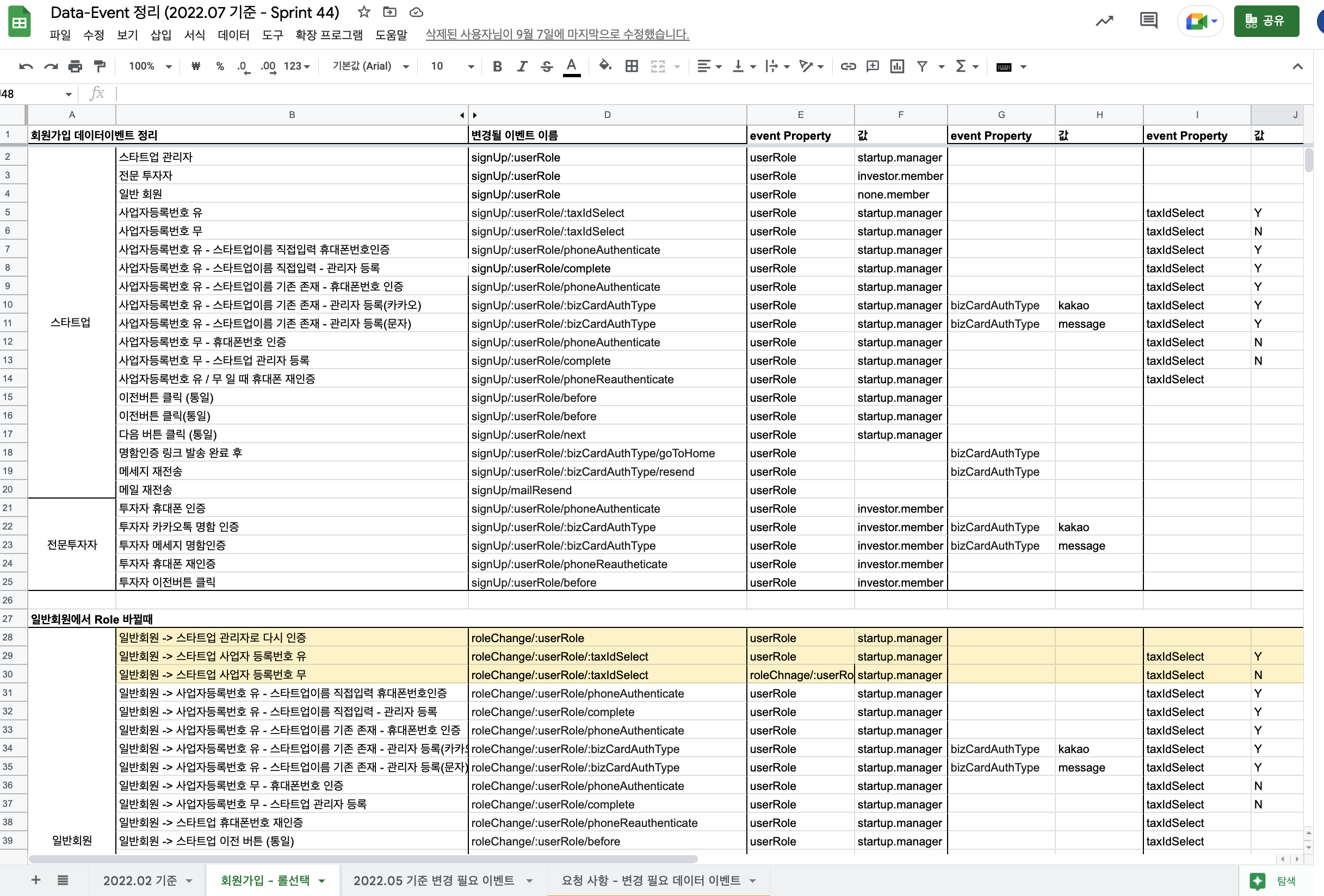
    Collaborated with the data analyst to redesign the product event taxonomy in parallel. Redefined the event structure around the sign-up funnel and key actions, enabling consistent tracking of which stage users dropped off or converted after acquisition.
  3. 3. Conversion Tag & GTM Governance
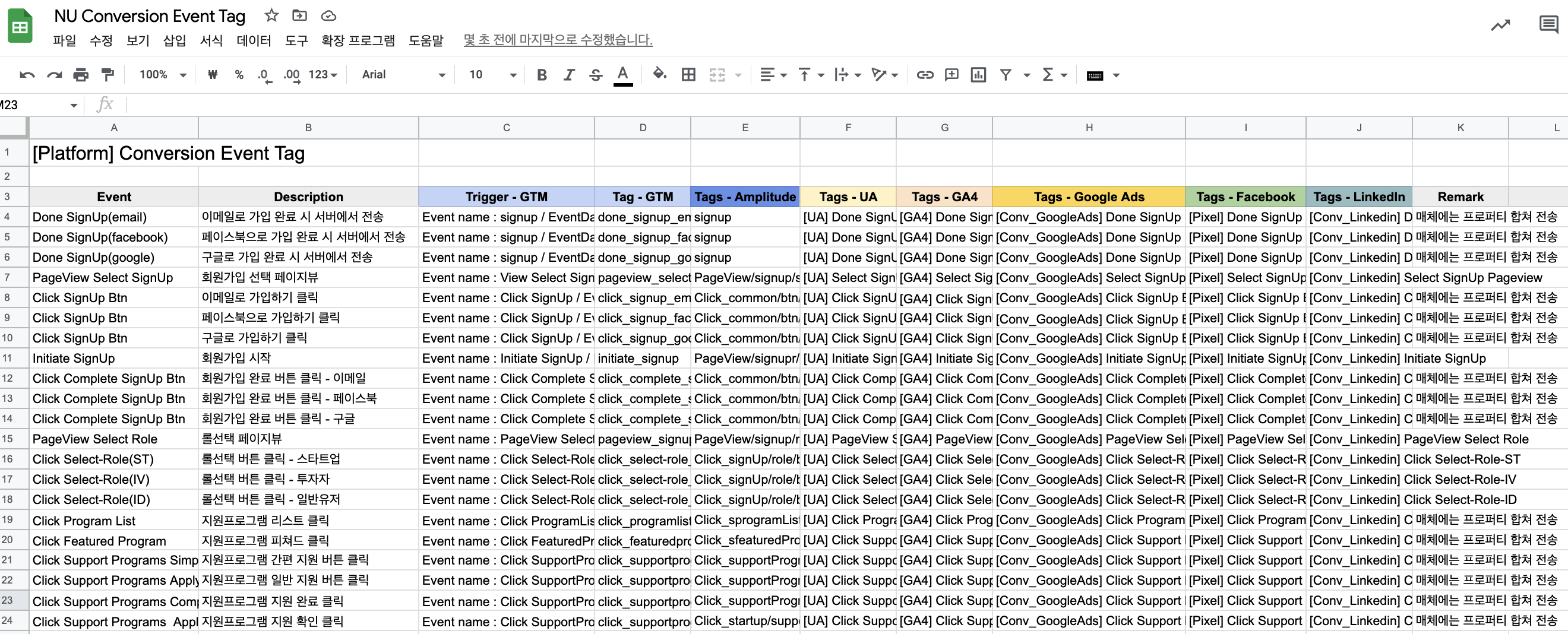
    Rebuilt conversion tags for each ad platform and established a GTM-based management framework, creating the foundation to measure sign-ups and key action conversions by channel.
  4. 4. User Property & Attribution Infrastructure
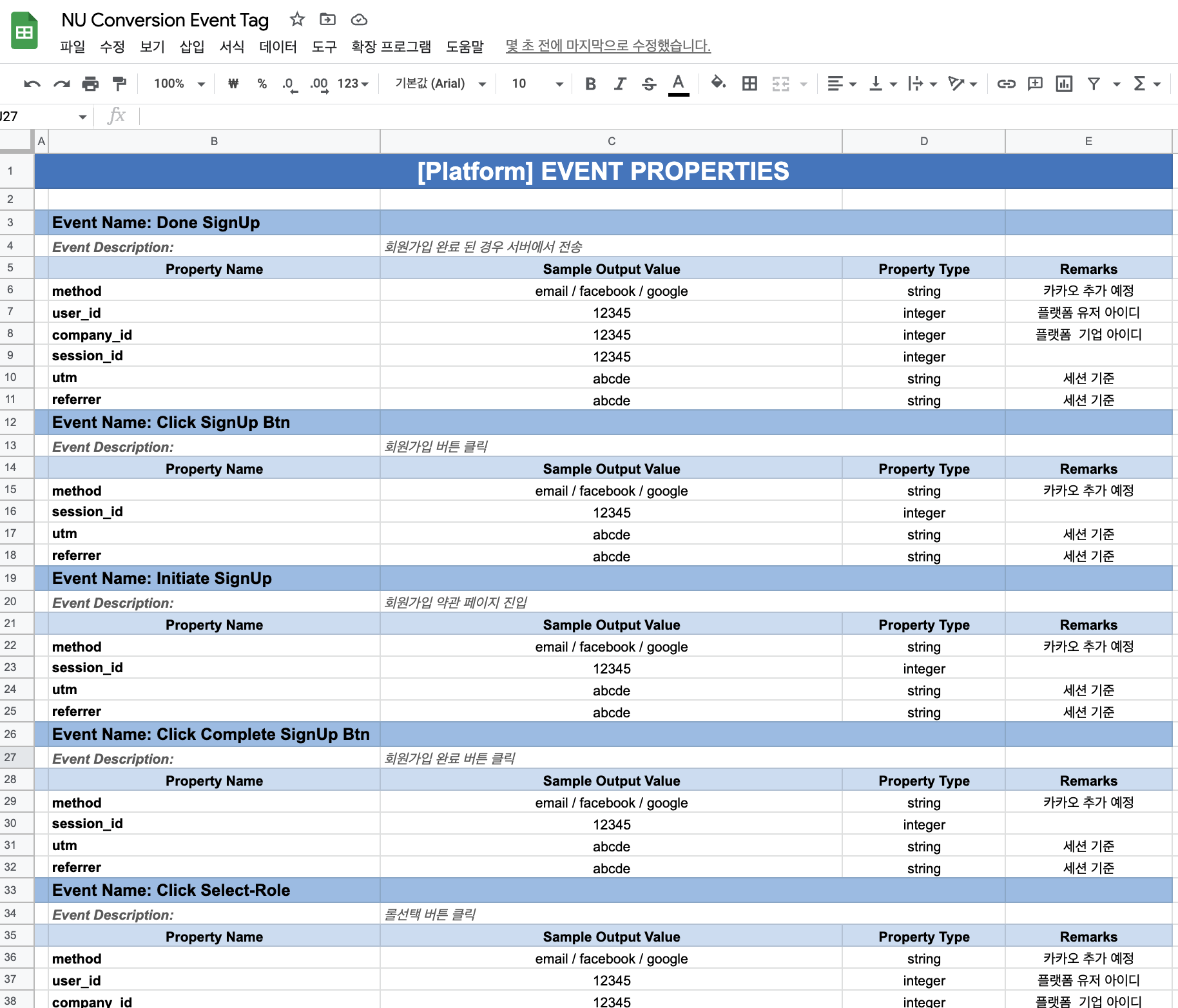
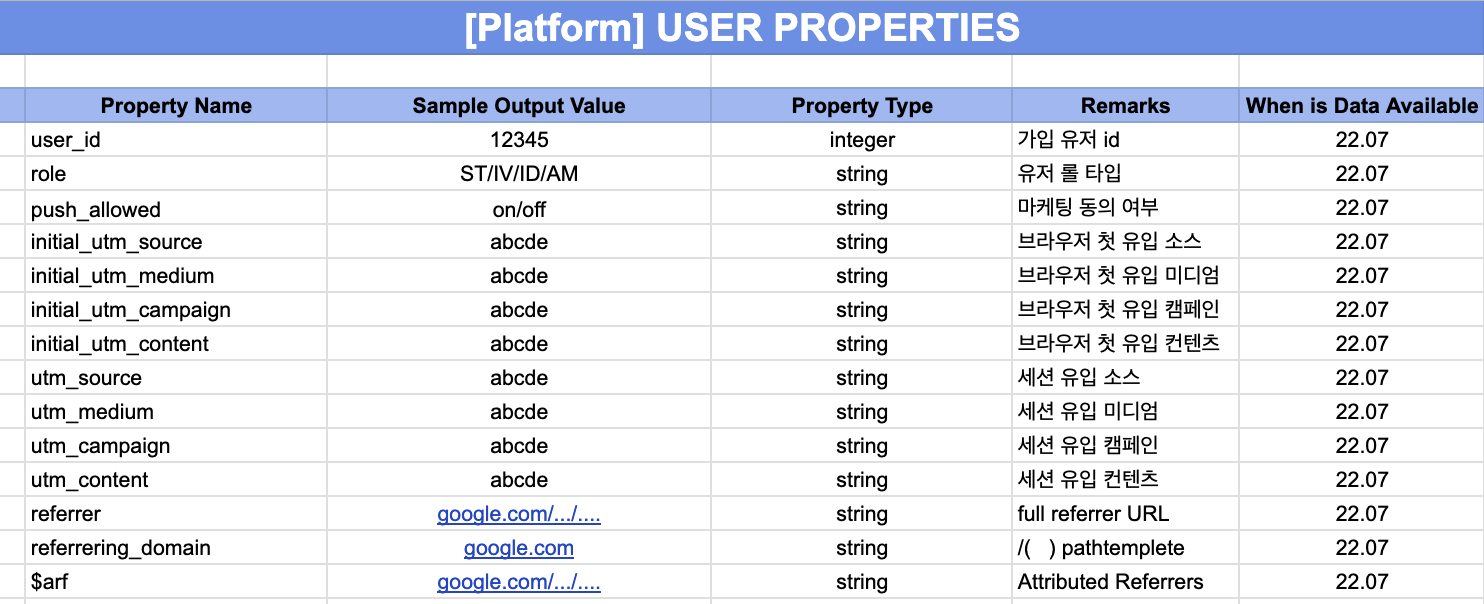
    Cleaned up key user properties including acquisition source, role, and referrer, and worked with developers and the data analyst to align ad platform data with internal logs — enabling user-level attribution tracking. Funnel, cohort, and retention analyses were subsequently performed by writing SQL directly, with dedicated marketing-specific tables created for analytical purposes.
UTM Builder documentation
UTM Builder
Data Taxonomy documentation
Data Taxonomy
Event Properties documentation
Event Properties
User Properties documentation
User Properties
Conversion Tag Mapping documentation
Conversion Tag Mapping
03
CHANNEL OPTIMIZATION & EXPANSION

Acquisition Channel Optimization

After establishing a measurable structure, I improved existing Paid channel efficiency while simultaneously testing new channels and scaling SEO. The goal was clear: reduce CAC without increasing budget, and broaden the acquisition touchpoints where sign-up conversions could occur.

Result

248%+

New user acquisition vs. prior year

43%

Paid CAC vs prior year
(53% reduction)

20%↓

Overall CAC decrease
after new channel introduction

150%

Organic content
acquisition growth

1. Paid Channel Efficiency Improvement

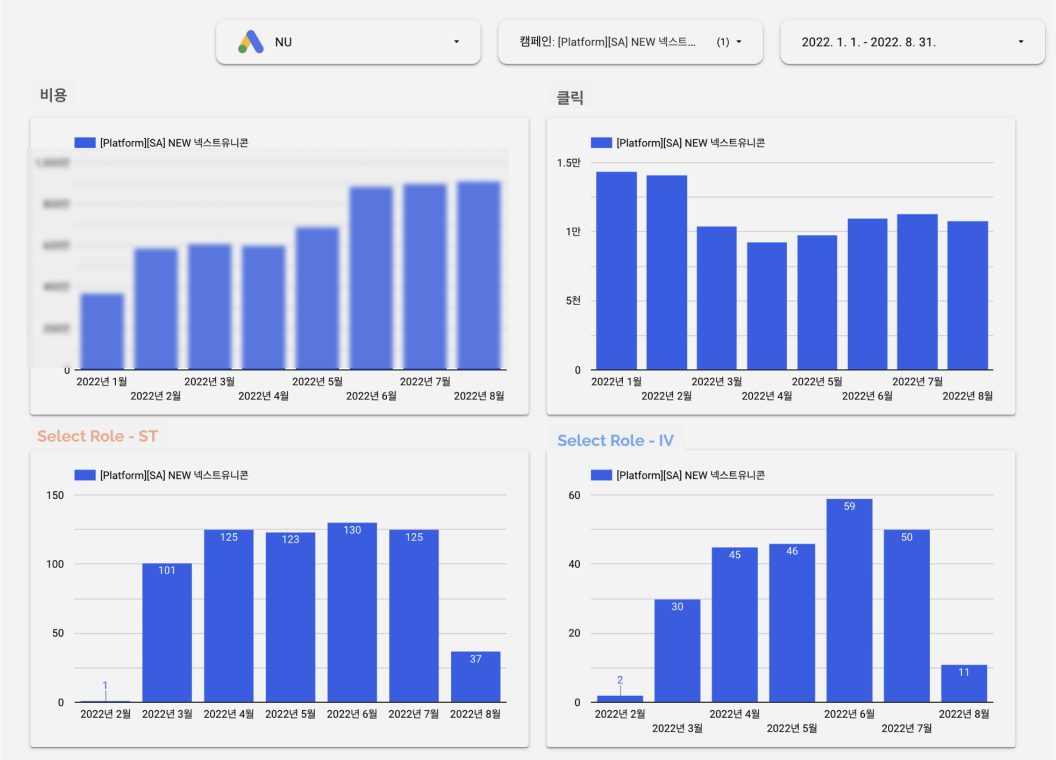
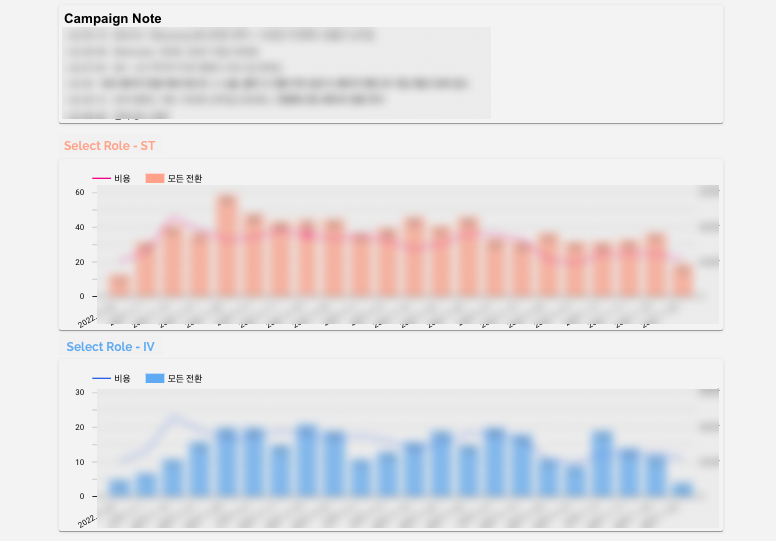
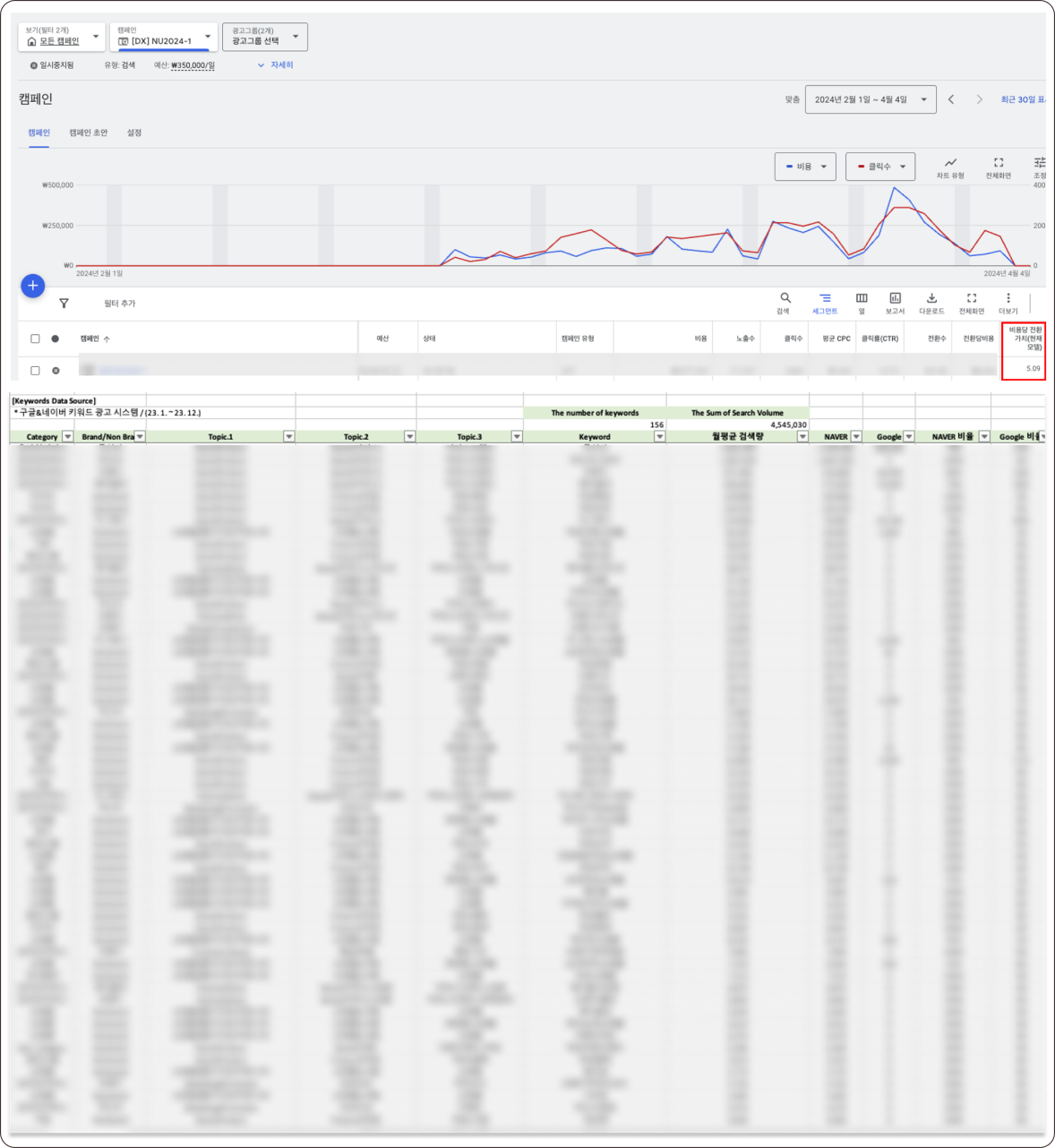
I reinforced search advertising and restructured Meta by splitting conversion-objective and traffic-objective campaigns into separate operations. Once the analytics environment was in place and channel-by-channel performance comparison became possible, I eliminated inefficiencies within the same budget and reduced Paid CAC by 53% year-over-year. Channel metrics were monitored continuously via a performance dashboard I built directly.

Nextunicorn paid channel dashboard showing cost, clicks, and role-based conversion performance
Paid Channel Performance Dashboard
Nextunicorn paid performance charts by role showing cost and conversion trends
Conversion Performance by Key Role

Paid CAC reduced 53% year-over-year

2. New Channel Testing & Channel Expansion

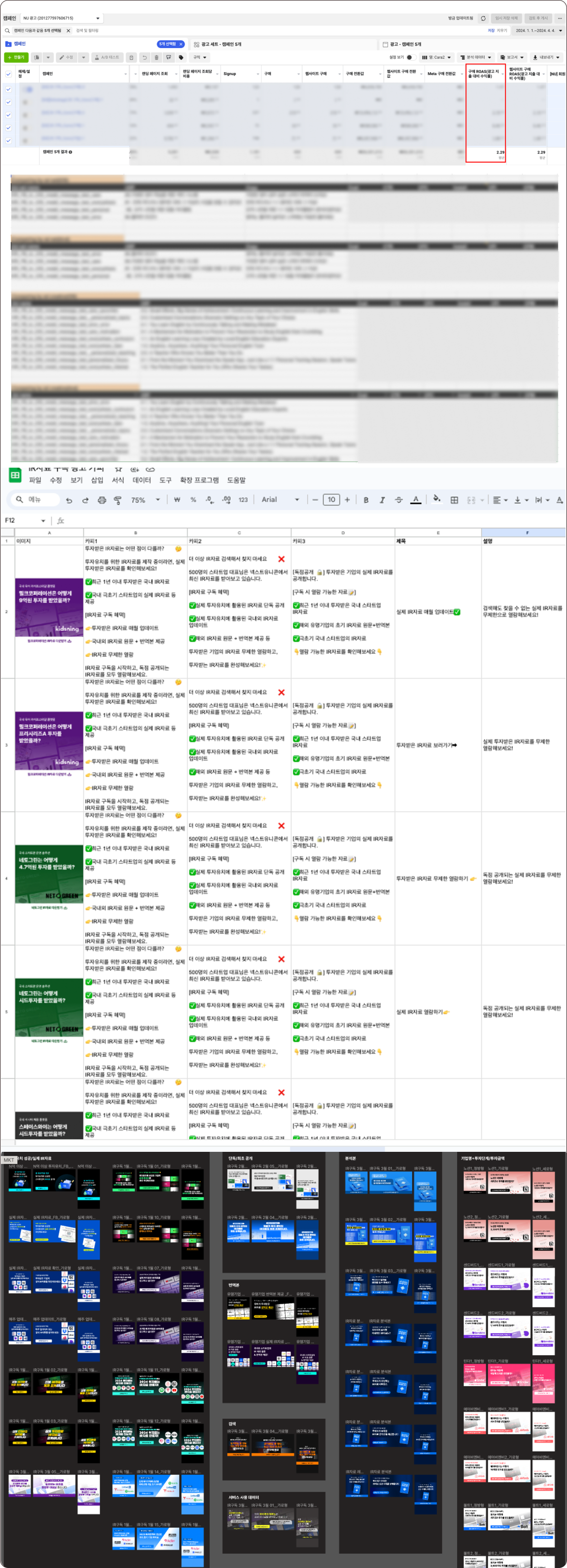
Introduced new Paid channels including Google Display Ads and LinkedIn to diversify the acquisition mix. Alongside expanding the channel mix, overall CAC decreased by 20% and sign-up conversion touchpoints were broadened.

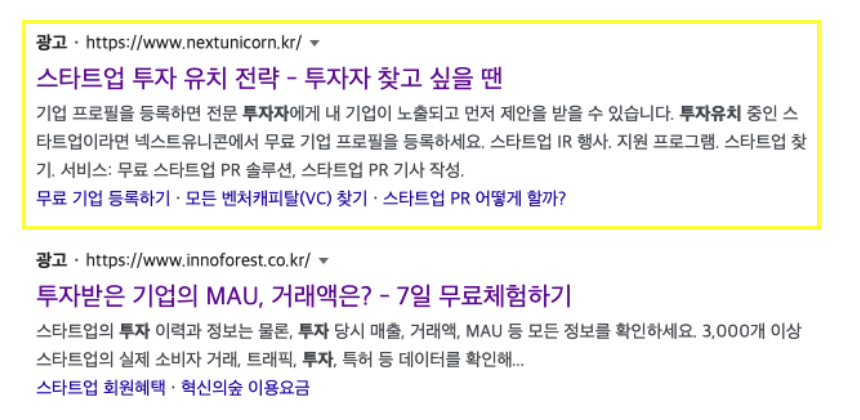
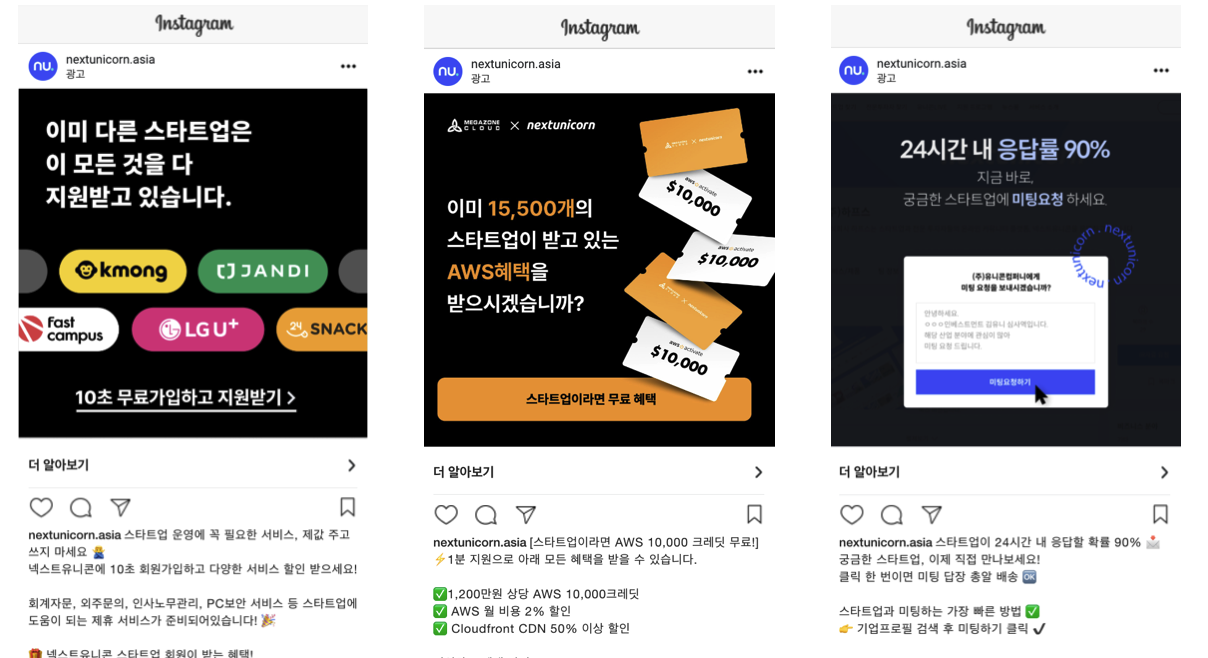
Beyond optimizing existing channels, I expanded acquisition touchpoints by running search ads, promotions, and new creative tests in parallel.

Search ad result example used for Nextunicorn acquisition testing
Search Ad & Acquisition Touchpoint Testing
Display and landing page ad creative examples used for new paid testing
New Paid Creative & Landing Testing
Instagram and promotional creative examples used for channel expansion experiments
Partnership & Promotion-Based New Channel Experiments

Overall CAC reduced by 20%

SEO Improvement

Technical SEO improvement → Content SEO improvement → Organic acquisition growth

In collaboration with the product and development teams, I revamped the insights HTML editor and added previously unsupported SEO features — including H Tags, Tables, Alt Tags, and OG tags — to establish the technical foundation. I also audited key SEO elements such as Meta Tags and Descriptions on the main platform and led the improvement roadmap. From there, I expanded startup guide and insights content to grow organic acquisition.

Technical SEO Improvement

Technical SEO Improvement

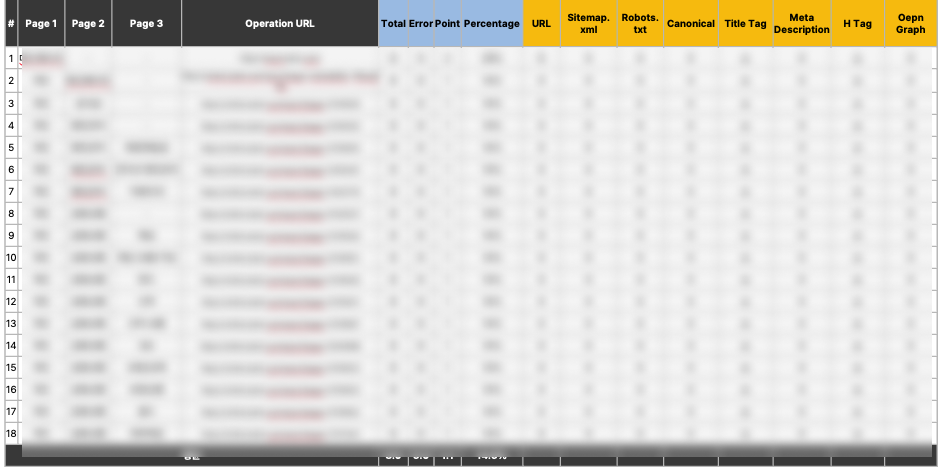
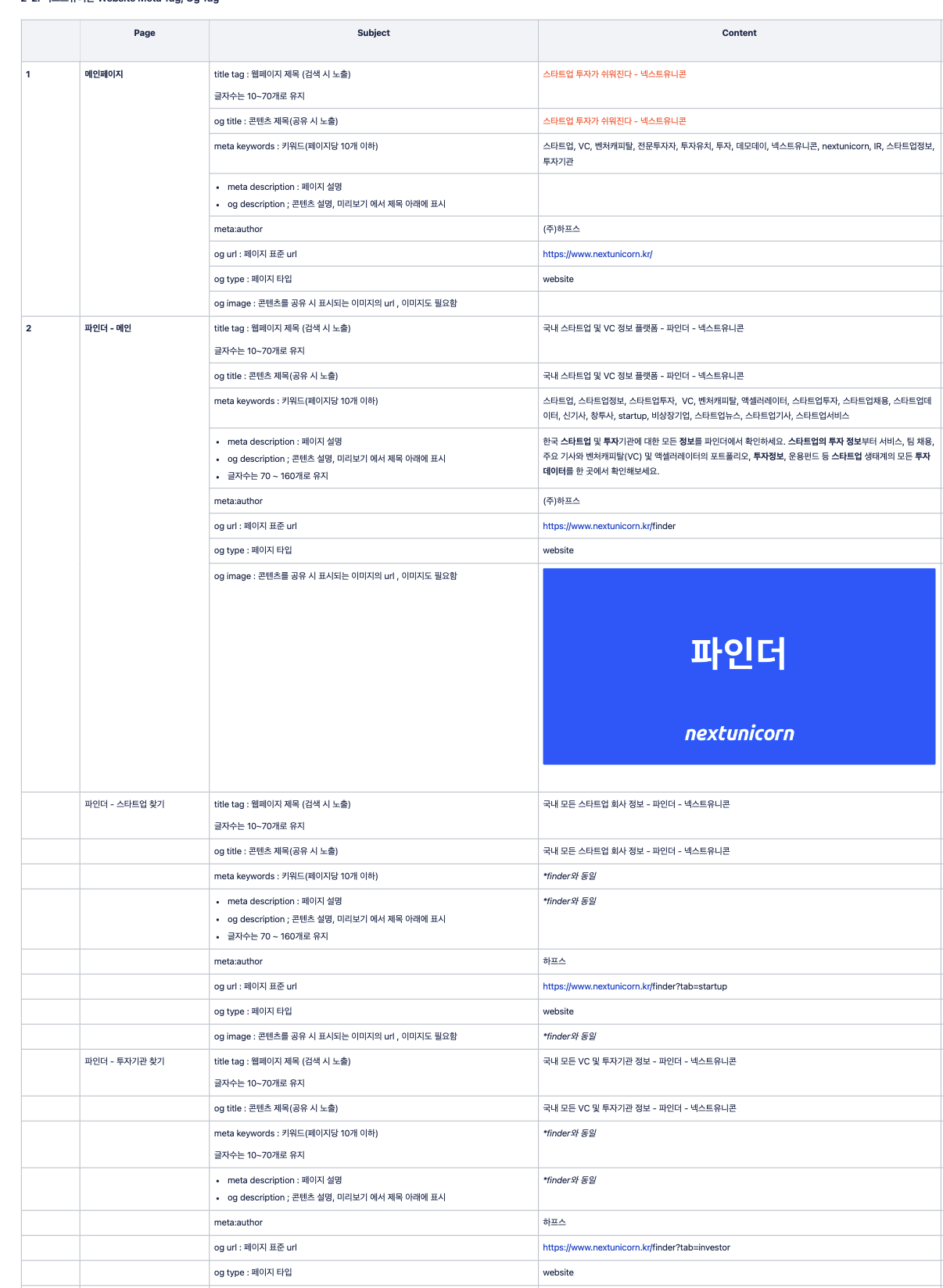
Revamped the insights HTML editor and added core SEO features — H Tags, Tables, Alt Tags, and OG — to establish the technical foundation for search visibility. Simultaneously audited key SEO elements such as Meta Tags and Descriptions on the main platform and led the improvement initiatives.

Technical SEO audit spreadsheet for Nextunicorn
Technical SEO audit
Meta tag and OG specification sheet for Nextunicorn technical SEO implementation
Meta tag / OG spec

Content SEO Improvement

Content SEO Improvement

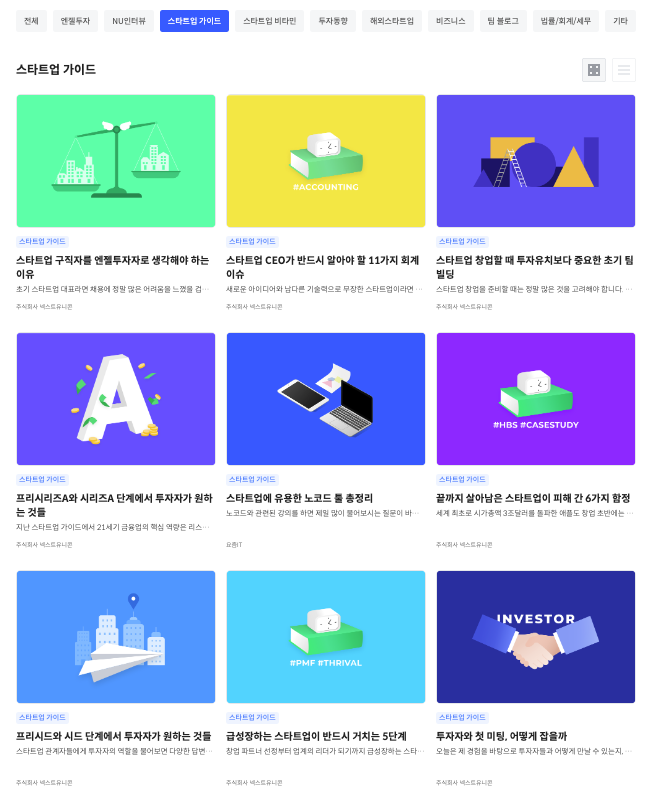
After establishing the technical foundation, I expanded startup guide and insights content, refined the content structure and exposure strategy with search acquisition in mind, and grew organic traffic.

Startup guide and category content page used for Nextunicorn content SEO expansion
Startup guide content
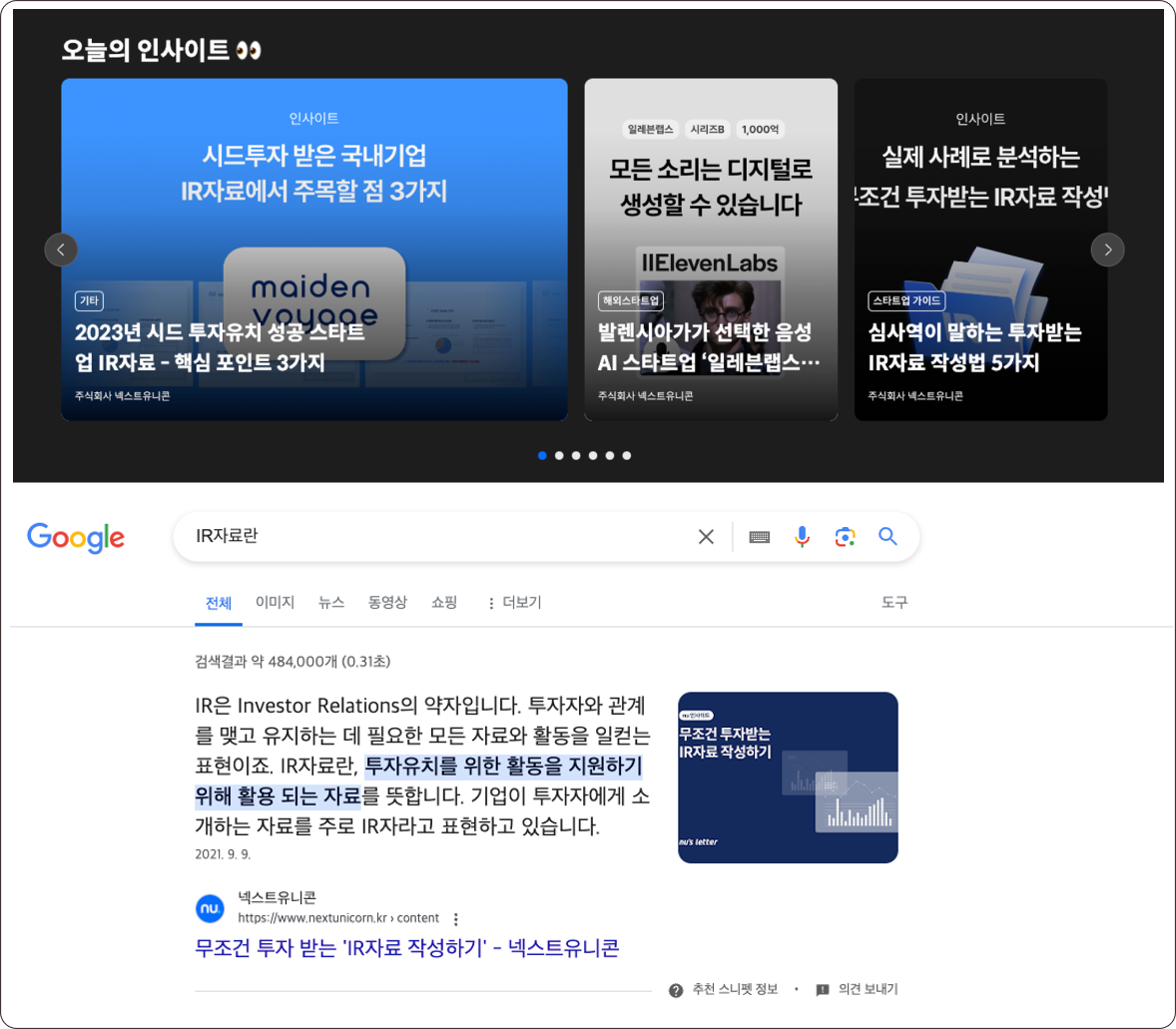
Google search result showing Nextunicorn content exposure for organic acquisition
Google search exposure
05
RESULT

Changing the acquisition structure brought CAC down and organic traffic up

After first getting the measurement environment in order, I simultaneously ran Paid efficiency improvements, new channel testing, and SEO. By separating each channel's role within the same budget and eliminating inefficient stages, I lowered Paid CAC by 53%. After introducing new channels, overall CAC dropped another 20%. SEO improvements expanded organic acquisition by 150%, building an acquisition structure less dependent on paid advertising.

This project didn't start with campaign execution — it started with measurement infrastructure. Optimization and expansion were impossible when we couldn't determine which channels were actually driving conversions. Defining "what standard do we use to evaluate performance" before anything else became the foundation for all subsequent execution: Paid optimization, new channel testing, and SEO expansion.

Networking Activation & CRM
01
THE CHALLENGE

The core networking problem wasn't connection — it was response

Investor Networking Usage Cycle

71% reduction

Startup Paid Ticket Repurchase

101% of target achieved

Nextunicorn's networking operated in an asymmetric structure where demand (startups) far exceeded supply (investors). On top of this, investor willingness to respond was low — when startups sent contact requests, most went unanswered. Startups expected to directly reach out to the investors they wanted, while investors only wanted to respond to startups that met their specific criteria. With neither group's expectations aligning, networking rarely led to responses or repeat usage.

Startup Pain Points

  1. 1 No response from investors
  2. 2 No way to follow up or reach out again
  3. 3 Investor responses take too long

78% of startups that initiated contact received no response, and the repurchase conversion rate was 67% lower than first purchase. Investors were also dissatisfied with a service structure that didn't allow follow-up communication such as document requests or meeting requests — at the time, the networking usage cycle averaged around 14 days on a quarter-over-quarter basis.

Investor Usage Cycle Comparison

After improvement Before
70% 70% 70% 0d +30d +60d +90d +4d +14d
Figure — The point at which investors reached the same usage threshold (70%) was moved forward from +14 days to +4 days, shortening the investor usage cycle
02
DIAGNOSIS

Both sides were using the same networking feature for entirely different purposes

Startups expected to directly reach out to their target investors, while investors only wanted to respond to startups that met their own criteria. With neither group's expectations aligning, networking failed to generate responses or repeat usage.

DEFINED PROBLEM

Because the divergent expectations and behavioral patterns of startups and investors were being handled within a single networking flow, activation could not be achieved through a one-size-fits-all operational structure.

03
STRATEGY

Tailoring to two groups that move differently, I separated investor activation and startup retention flows

I framed this not as a simple CRM operations problem, but as a structural issue: startups and investors operating with different expectations and behaviors. I began by analyzing the User Journey to map where each user group entered, what they expected, and where they became frustrated — then designed a separate CRM flow for investor activation and a separate flow for startup retention improvement.

04
EXECUTION

Investor activation and startup retention were each connected into distinct execution structures

Investor Activation CRM

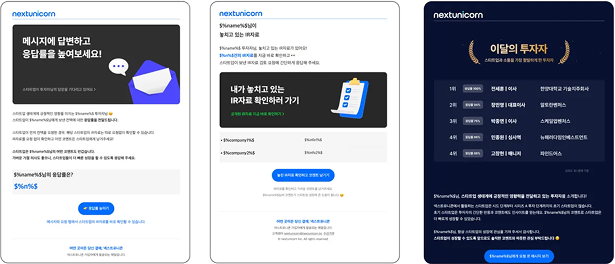
With 84% of domestic investment institutions already signed up, reactivating existing investors offered higher impact than acquiring new ones. I designed the CRM flow around social proof — the continuously expanding pool of startups contactable through Nextunicorn, with evidence that many other investors were already using it for deal sourcing.

Nextunicorn investor activation and startup retention CRM flow
CRM for Investor Activation

Startup Retention CRM

The core message for startups was continuity — 'you can try again at any time.' I redesigned the CRM flow to prevent churn after no-response and built a bridge to the next networking attempt.

Nextunicorn investor activation and startup retention CRM example
CRM for Startup Retention Improvement
05
RESULT

Reviving networking first restored the prerequisite for revenue

Improving the acquisition structure and growing organic traffic wasn't enough on its own — users who entered the platform but failed to receive responses in networking did not go on to repeat behavior or repurchase. In this project, I categorized the bottlenecks in the networking stage by type and designed intervention points and messages tailored to each barrier. For startups that churned after receiving no response, I built a flow that enabled them to try again; for slow-responding investors, I designed a CRM structure that more clearly surfaced deal sourcing opportunities. As a result, response rates in the networking stage improved, and conversion rates in the subsequent repeat-behavior stage rose in tandem.

The problem was structural, not messaging. Startups and investors were using the same feature for entirely different purposes. Only after reframing the problem — not as a retention decline, but as a misalignment between the behavioral structures of two distinct groups — was it possible to design differentiated communication strategies for each segment.

IR Subscription & Revenue
01
OPPORTUNITY

There was an open opportunity to scale recurring revenue structure around IR subscriptions

After getting the acquisition and networking structures in order, the next growth opportunity lay in growing startup users' information purchases and recurring revenue. IR document subscriptions were a product that, once the initial purchase conversion occurred, could lead to ongoing subscription retention and cross-selling — creating greater cumulative revenue than one-time payments.

02
BUSINESS OBJECTIVE

Revenue targets were broken down into first-purchase conversion, subscription retention, and cross-selling

There were three core objectives: increasing the first-purchase conversion rate for IR document subscriptions, improving subscription retention to grow recurring revenue, and expanding GMV through repurchase and cross-selling.

03
STRATEGY

I started by redefining who pays and why, then redesigned each channel's role

For the IR document subscription conversion project, I began by redefining who pays and why. I confirmed that information needs vary by investment stage and industry, that showing discount amounts more clearly than discount rates leads to better conversion, and that SA drives Last Touch conversion more strongly than DA — then redesigned the acquisition-to-payment funnel accordingly.

In the channel mix, Google SA was the key Last Touch conversion channel at an average monthly ROAS of 500%, while Meta DA handled awareness and consideration-stage user pool acquisition at an average monthly ROAS of 230%. By analyzing acquisition paths and conversion channels, I clearly separated each channel's role and optimized budget allocation.

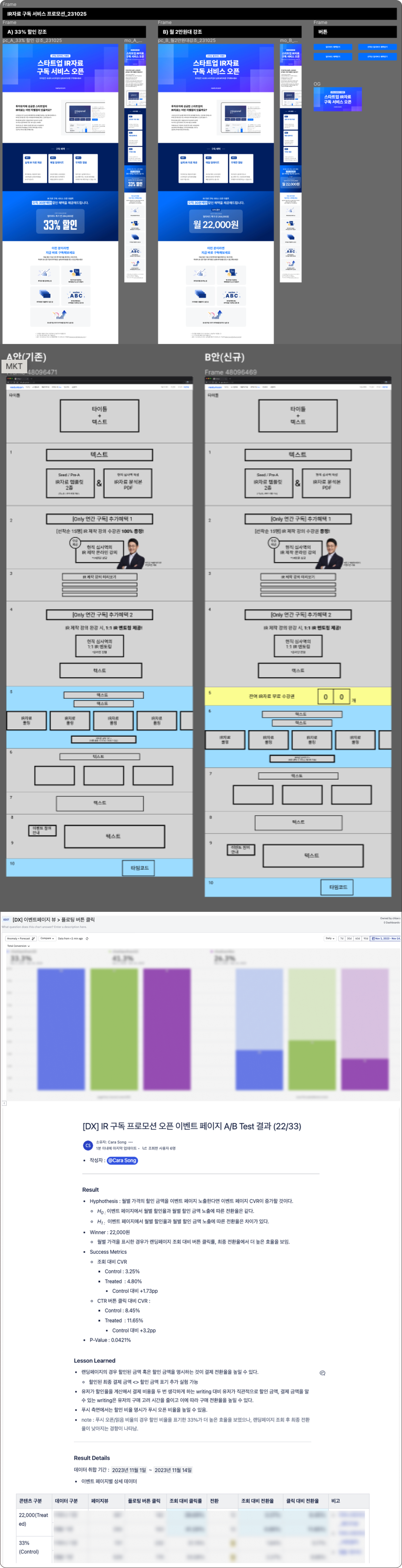
To increase first-purchase conversion, I planned and ran monthly promotions from the product launch, and continuously improved landing structures through A/B testing of promotion pages.

04
EXECUTION

Channel operations, experiment design, CRM and SEO execution were connected into a single conversion structure

Performance analysis showing SA driving strong Last Touch conversions in the IR document subscription project
Figure — SA driving strongly in Last Touch conversion with average monthly ROAS of 500%
Performance analysis showing DA contributing to awareness and consideration stage user pool acquisition in the IR document subscription project
Figure — Meta DA handling awareness and consideration stage user pool acquisition with average monthly ROAS of 229%
IR document subscription launch event page A/B test and promotion landing experiment
Figure — Continuously improving first-purchase conversion structure through A/B testing of promotion pages

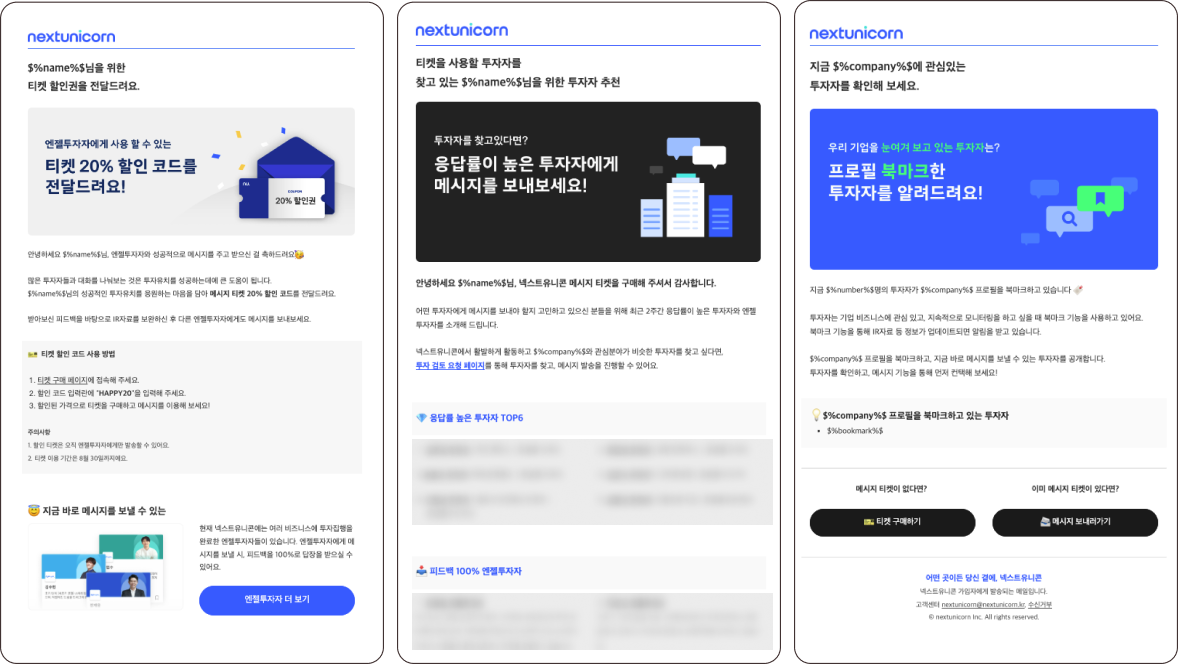
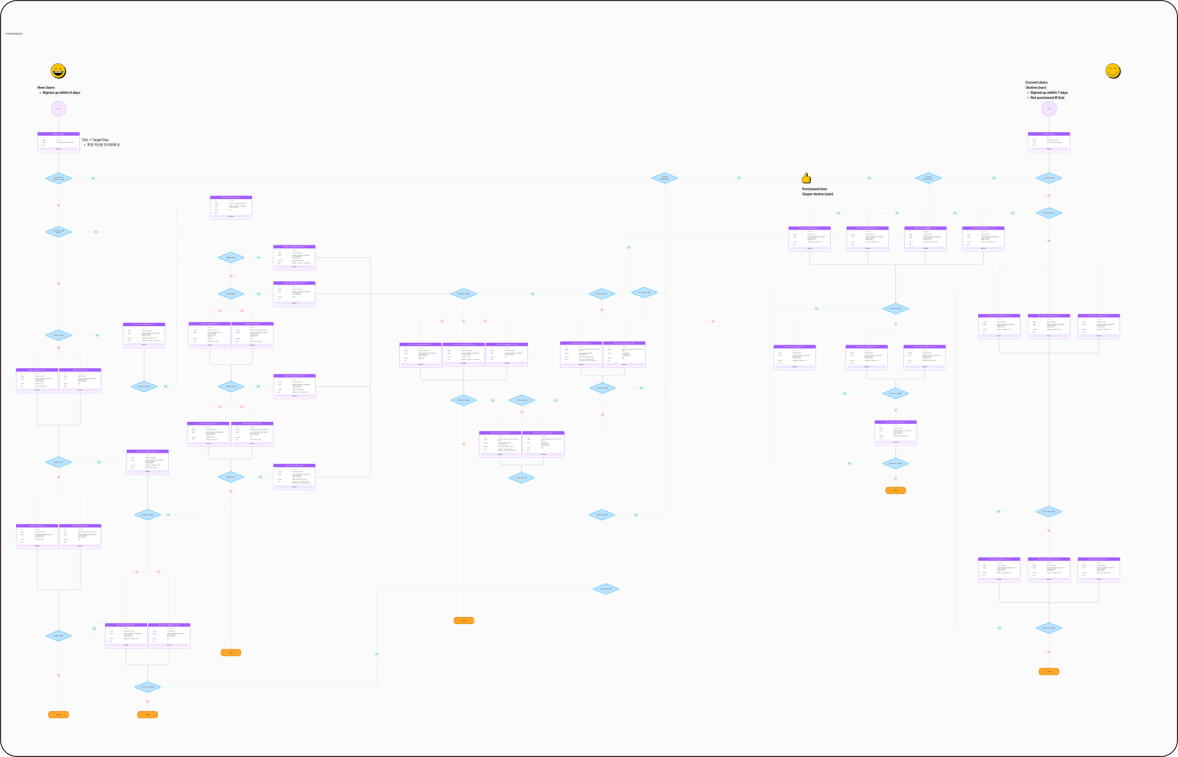
CRM flows were designed by segment based on User Journey analysis. Using 0 Party and 1st Party data, I segmented users by investment stage and industry, and repeatedly validated channel and USP combinations. This resulted in an average push conversion rate of 1.5% and a CRM contribution rate of 80%, and by analyzing payment funnel drop-off points, I reduced the exit rate by 5.5%p.

IR document subscription CRM flowchart
Segment-Based CRM Flow Design
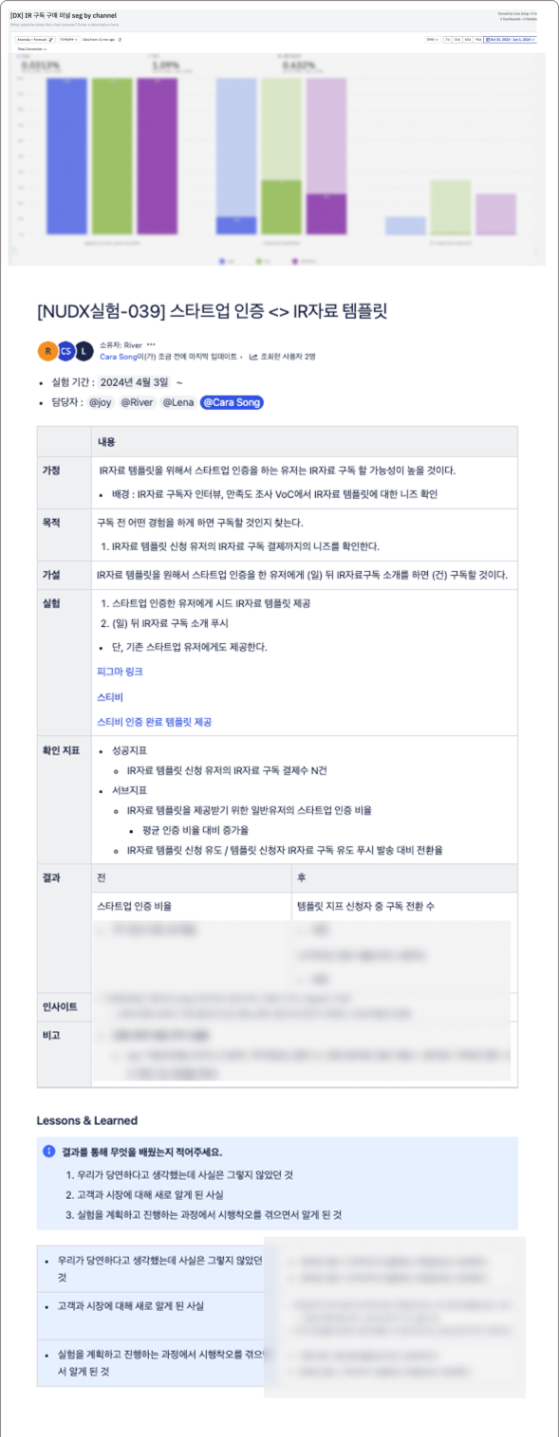
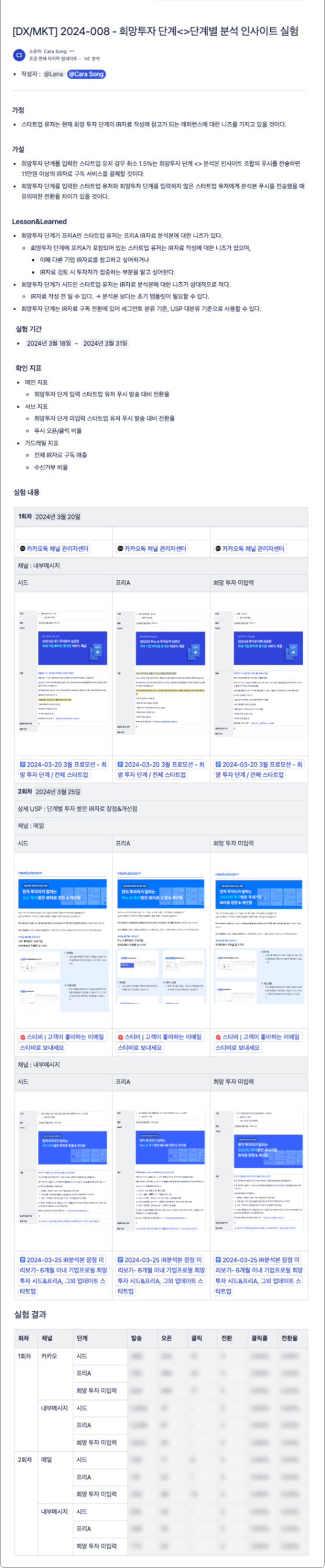
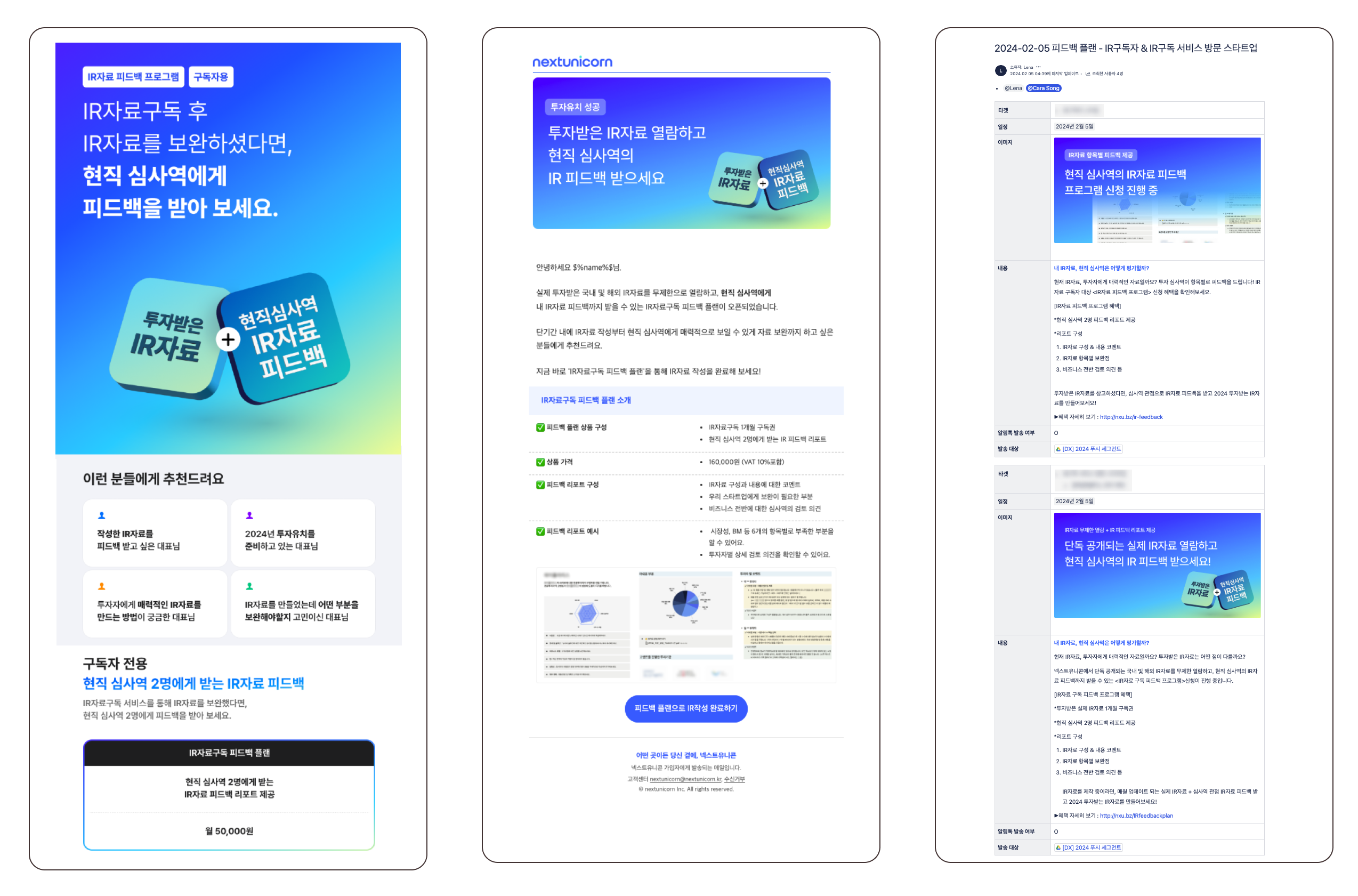
IR document subscription experiment design document
Experiment Design & Execution Document
IR document subscription execution document
Experiment Design & Execution Document
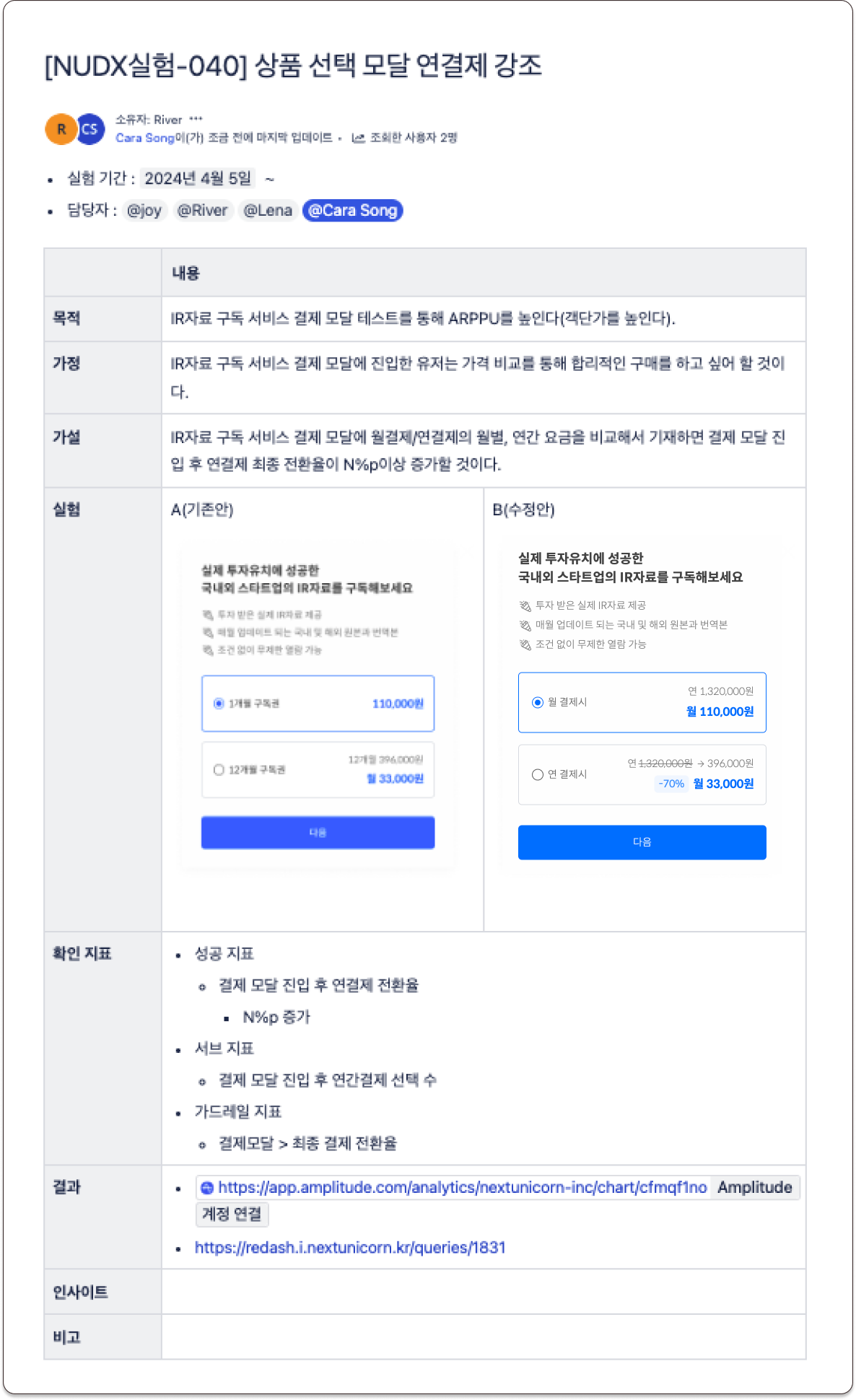
IR document subscription payment modal improvement proposal

Payment Modal Experiment Proposal

IR document subscription payment modal original version

Payment Modal A/B Test Exposed UI

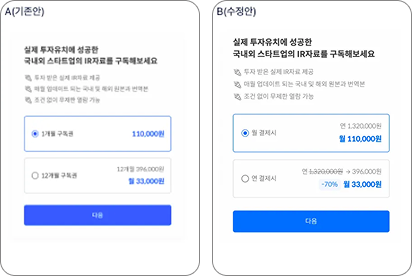
In collaboration with the PM, I ran a payment modal UI improvement experiment. The hypothesis was that displaying monthly and annual payment amounts on the same basis would create the perception that annual billing is more reasonable, thereby increasing annual payment conversion rates. I was involved from the planning stage, designing and executing an experiment that changed the price display format.

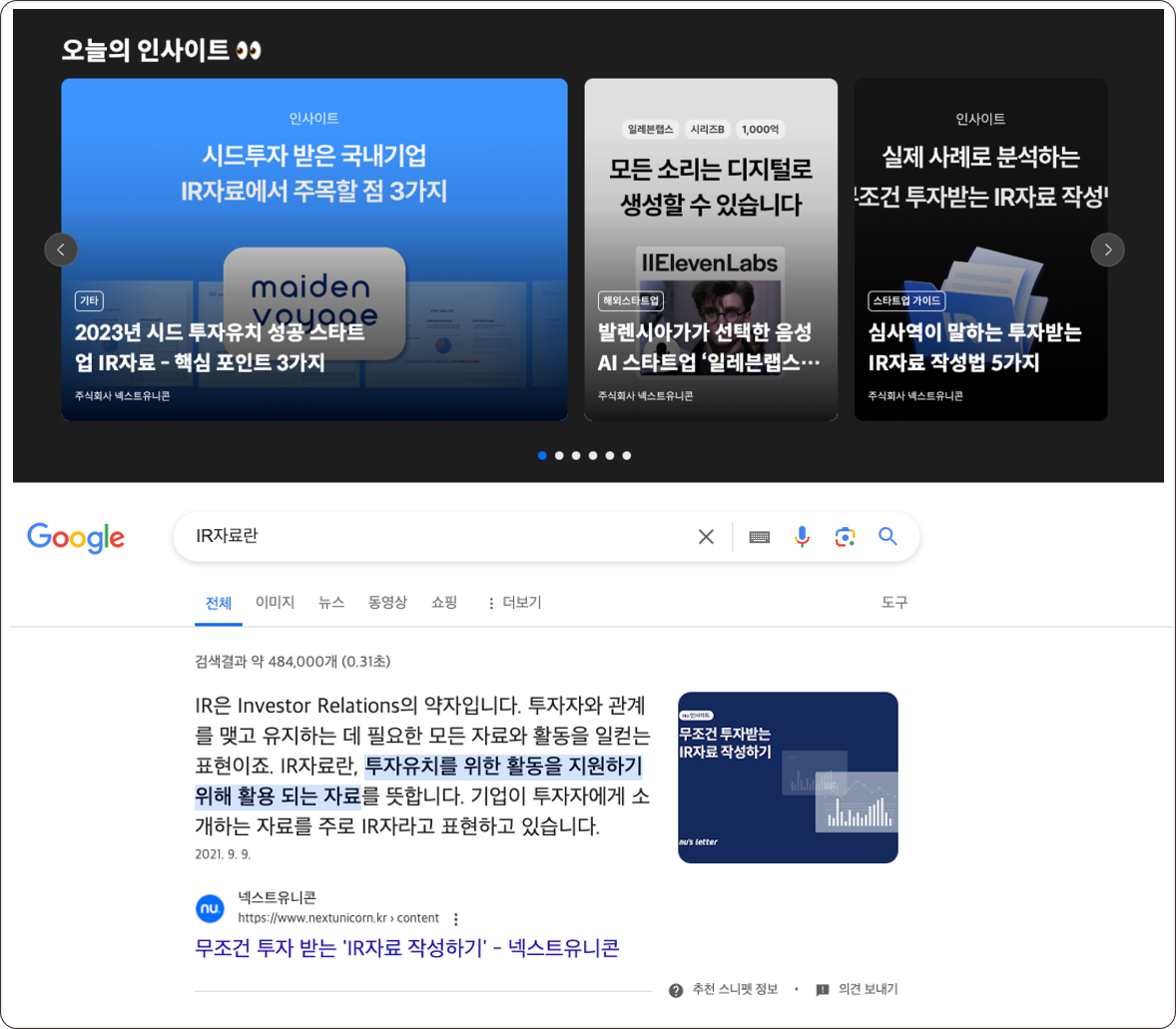
Screen showing Nextunicorn appearing as the top Google SERP snippet for IR document-related keywords
Figure — Appearing as the top Google SERP snippet for high-conversion-potential keywords, contributing to subscription service awareness

I also ran SEO content in parallel to grow acquisition. By identifying high-conversion-potential keywords and planning and publishing content, I achieved 200%+ content acquisition growth, and contributed to subscription service awareness through top Google SERP snippet exposure.

Subscription Retention Structure Improvement

Once first-purchase conversion stabilized, the next challenge was subscription retention. I segmented subscribers by stage — pre-IR document creation, in-progress, and in revision — and analyzed the needs and cancellation reasons for each state. The primary reasons for cancellation at the 1-month mark were "I've reviewed enough references" and "I can find alternatives through search." Accordingly, I redesigned the churn prevention CRM flow around the importance of staying current with the latest IR document trends and the appeal of exclusive content unavailable through search engines, achieving a 20%p improvement in Unbounded Retention M1.

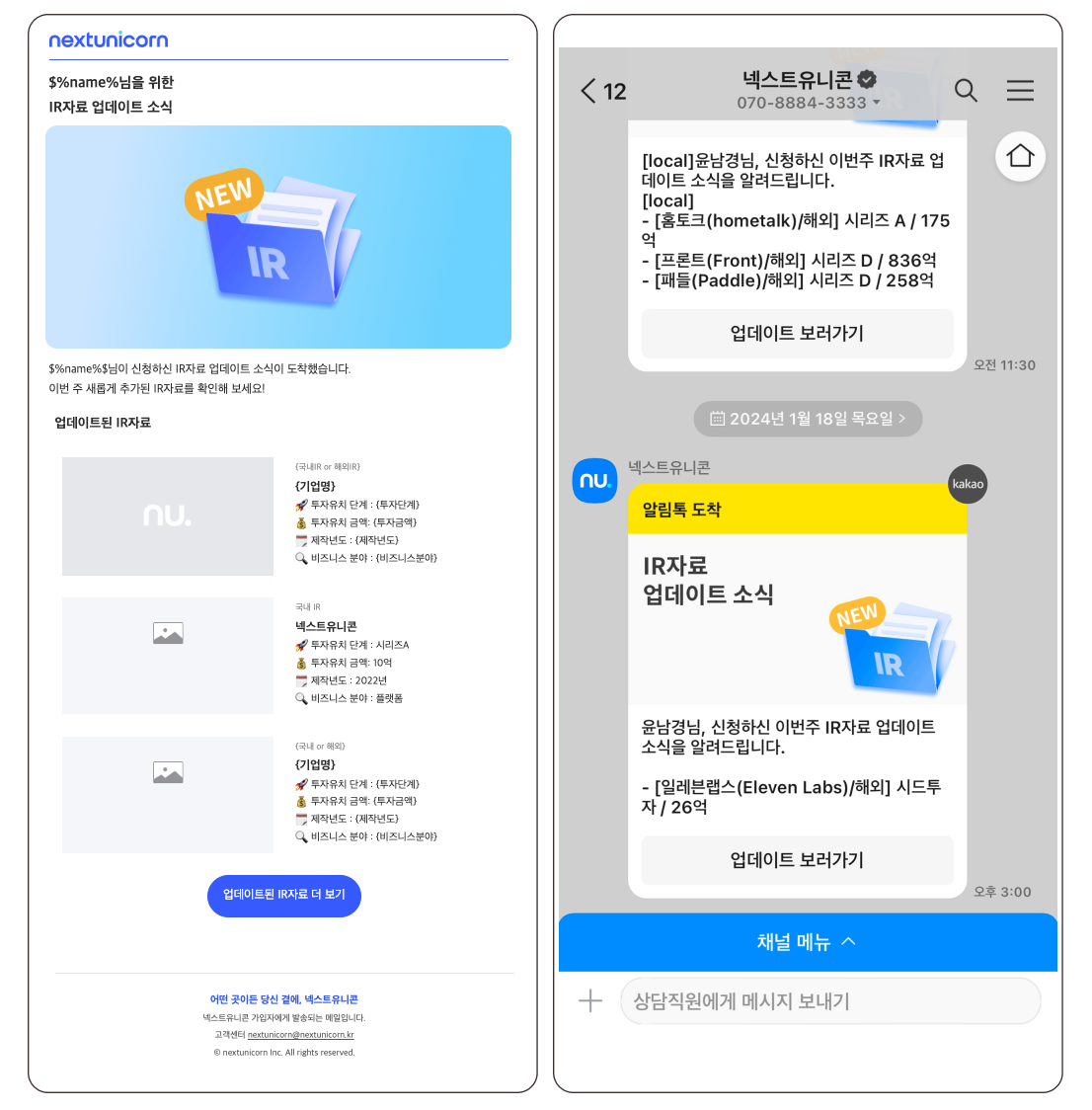
IR document update notification CRM example
IR Document Update / Re-engagement CRM Example
IR document subscription CRM example
IR Document Subscription / Feedback CRM Example

Paid Program Cross-Selling Expansion

Once retention stabilized, I moved to the cross-selling phase: connecting subscribers to paid programs. Based on first-purchase user cohort analysis, I designed and executed a CRM flow converting subscribers to investor pitch review and office hours, converting 3% of subscribers to paid programs. Repurchase, AOV, and Recurring Revenue were all managed within a single funnel.

05
RESULT

First-purchase conversion was established, then revenue structure expanded through repurchase and cross-selling

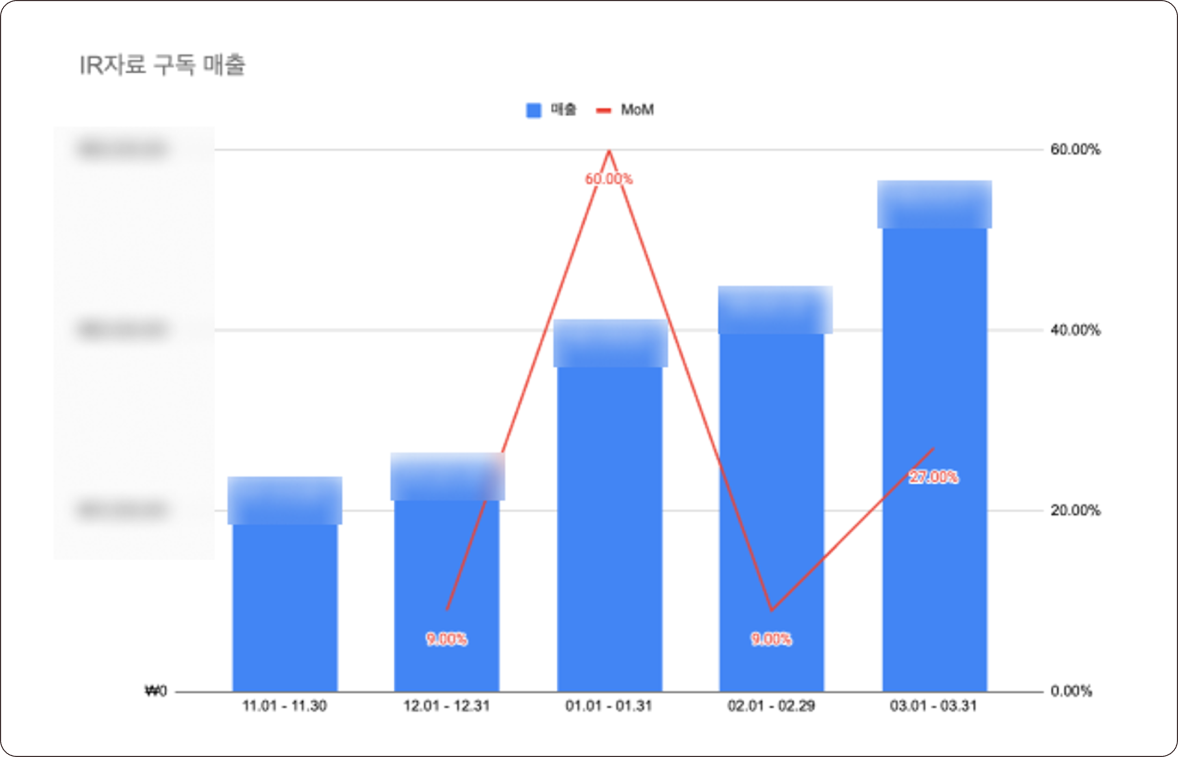
IR document subscription revenue growth graph
IR Document Subscription Revenue Growth Trend
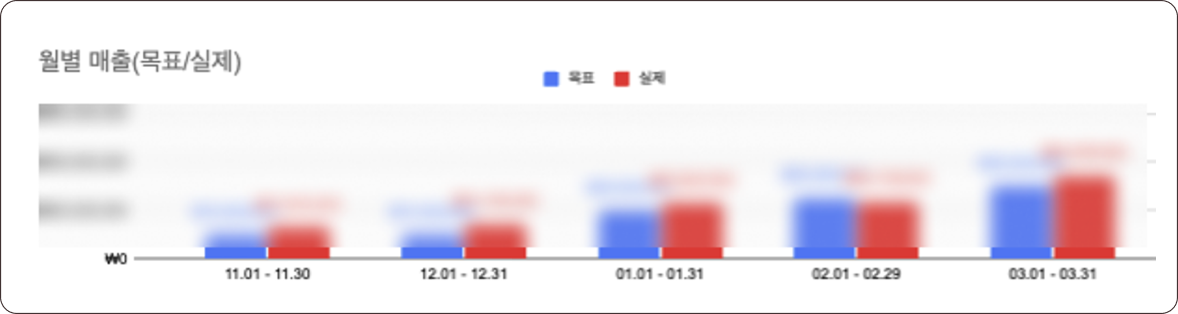
IR document subscription actual vs. target graph
Monthly Actual vs. Target

Subscription

133%

Monthly avg. Blended ROAS

Growth

+26%

GMV MoM growth

Recurring

+17%

Recurring Revenue MoM

In the IR document subscription conversion project, I began by redefining who pays and why, and redesigned the acquisition-to-payment structure to match each channel's role. SA was operated as the key Last Touch conversion channel, Meta DA as the awareness and consideration-stage user pool acquisition channel, and promotions, landing structures, and CRM flows were improved together. As a result, first-purchase conversion stabilized, and subscription retention improvement and paid program cross-selling followed — creating the foundation for revenue expansion.

The core of this project wasn't improving subscription conversion rates — it was designing retention and expansion after the first purchase as a single, unified structure. A payment isn't the end of an action; the entire revenue structure changes depending on what content is experienced afterward and which programs users move into. So rather than treating acquisition, first purchase, retention, and cross-selling as separate concerns, I designed them as a single flow — and as a result, was able to extend into a recurring revenue structure.

Retrospective

What it means to structure every channel as a solo marketer

01

Starting where there is no infrastructure

The first problem I encountered at Nextunicorn wasn't channel efficiency — it was that there was no unified standard for evaluating performance in the first place. Acquisition parameters, event definitions, conversion benchmarks, and internal log interpretations all differed by team, meaning that looking at the same data could lead to entirely different conclusions. What this experience taught me was that the first action in an environment with no infrastructure isn't campaign execution — it's making sure the team can read the same numbers with the same meaning. Ever since, when starting any new action, I first ask: "Can everyone interpret these results using the same standard right now?"

02

Translating company-wide direction into impact-based priorities

Company-wide objectives always came as broad directional goals, but in actual execution they needed to be translated into which problems to solve first. At Nextunicorn, acquisition, networking, subscription, repurchase, and cross-selling were all interconnected — so rather than chasing tasks that created big numbers on the surface, I had to first determine what the prerequisite conditions were that would unlock the next stage of performance. Prioritization was difficult precisely because every task seemed equally important simultaneously. The standard I set for myself was a single question: is the problem I'm solving right now a prerequisite for the next result, and will solving this problem actually open up the next behavior and the next revenue? So rather than short-term metrics, I started by identifying where the flow was blocked, and prioritized tackling whichever problem would unlock the greatest impact.

03

What changed when I started seeing all channels together

When operating Paid, SEO, CRM, and promotions separately, it's easy to evaluate each channel's performance in isolation — but in reality, they all existed within a single user journey. Paid created acquisition, SEO created long-term demand, and CRM changed the behavior of users who had already entered. This experience also changed how I evaluate channels. Now, rather than "did this channel perform well?", the more important question is how this channel connected to the next behavior and the next revenue. Seeing all channels together doesn't simply mean operating multiple channels — it means learning to evaluate each channel's role by connecting it to the user's journey and the business structure as a whole.

Next Project

From a Pro's First Quote to Revenue Expansion: Awakening Soomgo's Growth Engine

Soomgo · Purchase → Quote → Revenue

arrow_forward